A robot arm can look fast in a factory video and still lose money on the production line. The global race to build better industrial robots should be judged by working hours, useful payload, service cost, and safe recovery from faults.
- Robot speed matters only when the full work cycle gets shorter.
- A lower purchase price can disappear if setup and service take longer.
What “better” should mean
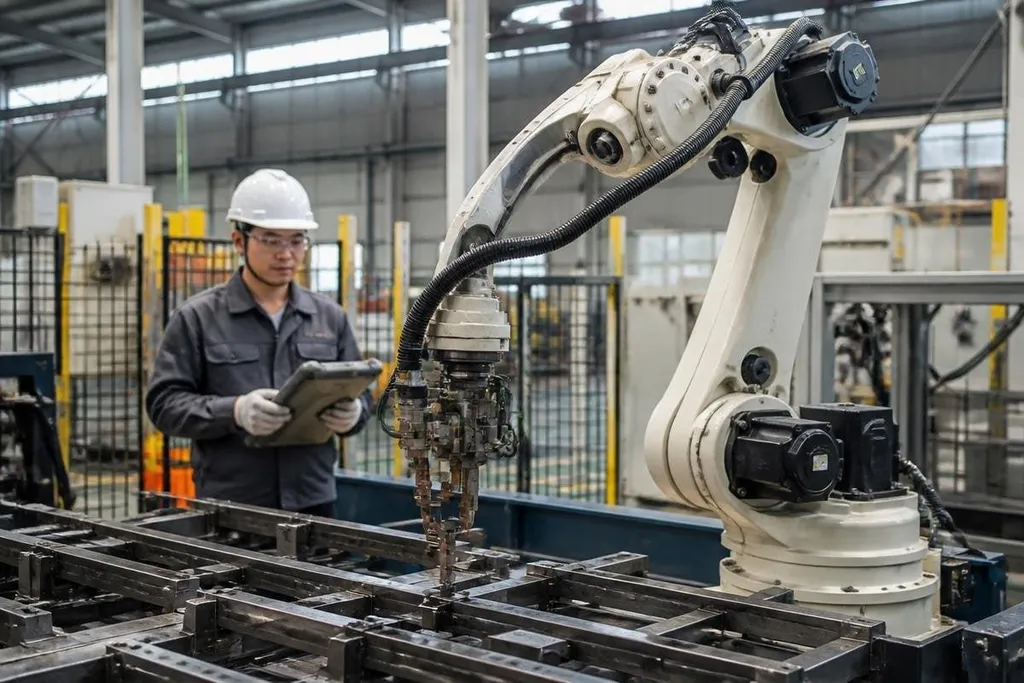
Industrial robots do repeatable work inside a fixed area. They move parts, weld joints, load machines, sort goods, or apply material along a planned path. Their value depends on how well the robot handles the task around it, not on the number of joints in the arm.
Four measures give a clearer starting point: cycle time, payload, reach, and uptime. Cycle time shows how long one completed job takes.
Payload tells you the mass the robot can carry at a stated reach and speed. Reach describes the work area, while uptime shows how often the cell can produce parts instead of waiting for a fix.
Shorter cycle time may still lose money if the gripper drops parts twice per shift. A larger payload may need a heavier base, more floor space, and more power. Each number needs its working conditions beside it.
The factory decides the winner
A factory does not buy a robot in isolation. It buys a cell that includes the arm, controller, gripper, cameras, safety equipment, software, tooling, and a way to move parts in and out.
That wider system changes the cost. Systems that need hand-written code for every product change may slow a small production line. Machines that work with common programming tools may let the same technician change a task without waiting for the maker.
The first setup also matters. A machine that takes two days to install has a different cost from one that needs three weeks of wiring, calibration, and safety checks. Any fair comparison should count the lost production during that period.
That lost-production cost needs evidence from real factory deployments. Dated reports at Robot24 can add machine names, tasks, and stated limits to the comparison before the next section looks at what the specs leave out.
The hard limits are easy to miss
Industrial robots work best when the task stays inside known limits. Changes in part shape, surface finish, lighting, grip, or position can force a new program or stop the cell until someone checks it.
Sensors can help the robot find parts and detect errors. They don't remove the need for safe motion planning, guarding, emergency stops, and trained staff. A camera may find a part, but the robot still needs a controlled path and a gripper that holds the part under force.
Service is another test. Buyers need to know which parts fail, how long repairs take, and whether the maker keeps motors, drives, cables, and controllers available. A low purchase price means little if a failed drive stops a line for weeks.
The open question is how much work newer software can handle without a person checking each change. A system may adapt to a new part in a lab and still need close supervision on a busy line.
A practical buying check
Use this list before comparing robots from different regions or makers:
- Name the job: record the part, tool, cycle, force, and handoff point.
- Set the load: measure the full payload, including the gripper, cable, and part.
- Time the cell: count loading, movement, processing, unloading, and error recovery.
- Price the support: include installation, training, spare parts, software fees, and service travel.
- Test the fault: pause the robot during a real cycle and check how staff restore production.
- Check the changeover: time a new product setup with the people who will run it.
This process also makes claims easier to test. A maker can state a repeat time, but the factory should measure the complete cell cycle. A maker can list maximum payload, but the buyer should check the load at the required reach and speed.
My view is plain: the best industrial robot is the one that keeps the line running after the demonstration ends. The next useful scoreboard will need public factory data on uptime, repair time, and full installation cost, not another top-speed video.